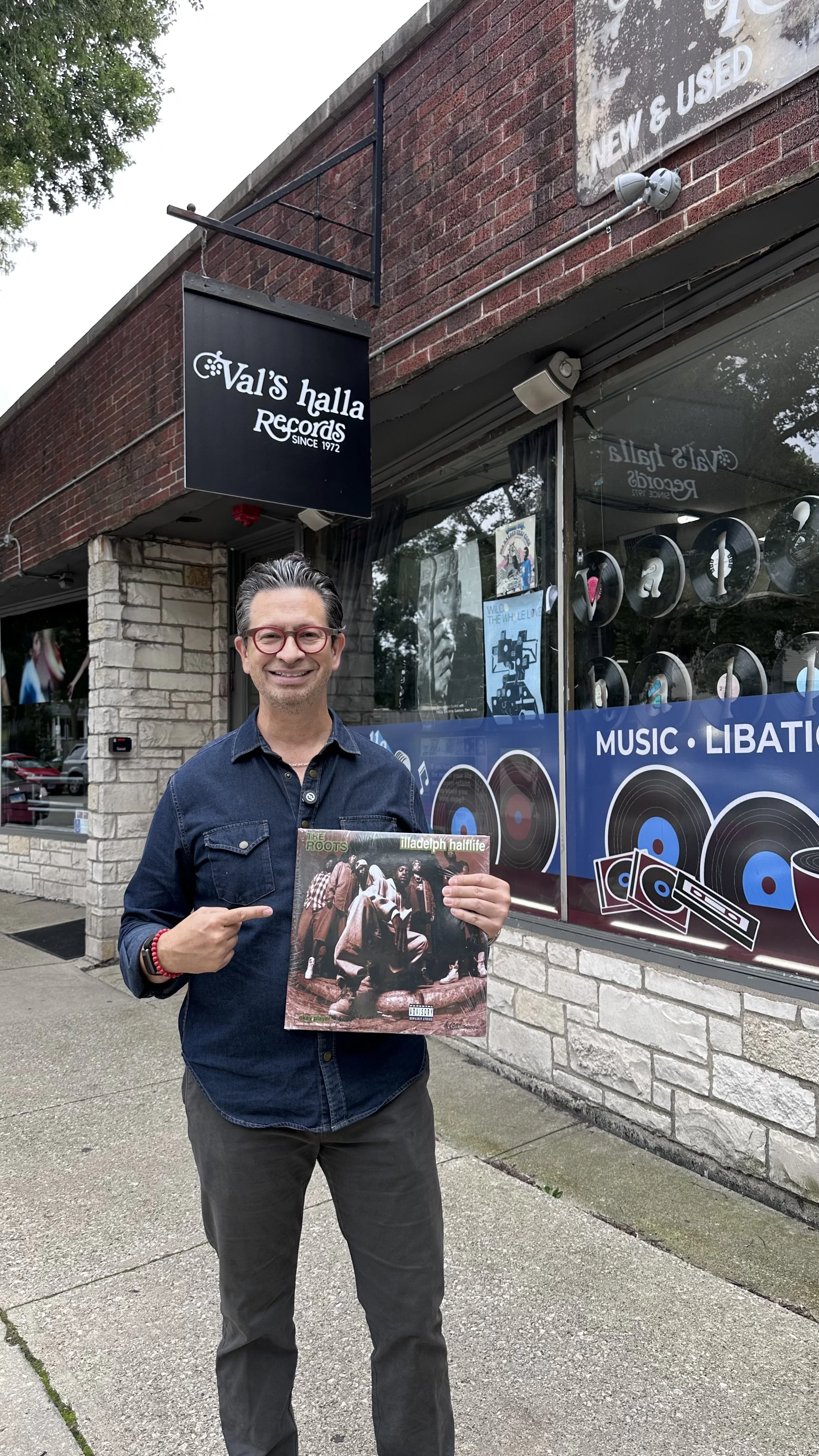
On my recent visit to Val’s Halla Records in Oak Park, there was plenty to take in before I even started looking through the bins. Handwritten dividers. Posters on the walls. Records overhead. Details that give you reasons to keep looking around.
I walked out with Illadelph Halflife by the Roots, one of my favorite bands. So, yes, a successful visit.
But the store also got me thinking about the places that give a neighborhood its personality. The businesses people return to for years. The places you bring a friend who’s visiting because you want them to understand something about where you live.
A record store can be one of those places. Spend a little time inside and you might learn something about the neighborhood outside its door.
Val’s Halla Records in Oak Park: A Neighborhood’s Memory
Val Camilletti opened Val’s Halla in 1972. Over the years, it became a familiar stop for generations of music lovers, including Oak Park–River Forest students who visited during lunch or after school. The store moved from South Boulevard to Harrison Street in 2006, bringing its history—and its famously quirky Elvis shrine—along with it.
That last detail says something. Before the move, customers wanted to know whether the shrine was coming, too. People get attached to the peculiarities of a place. They become part of what makes it theirs.
Today, Val’s Halla sits in the Oak Park Arts District, among the small businesses and creative spaces along Harrison Street. Val herself helped support that community through her involvement on the district’s board. The connection between store and neighborhood was something she actively worked on.
Oak Park gets plenty of attention for its architecture. A place like Val’s Halla offers another way to understand it: through the people who build something, put their personality into it, and give others a reason to keep coming back.
Take a look inside Val’s Halla with me in this short tour
606 Records in Pilsen: Room for Discovery
At 606 Records in Pilsen, the selection offers a different entry point into neighborhood life.
The independent shop and label, established in 2015, focuses on independent artists and labels from Chicago and around the world. Chicago magazine recognized it for a selection that reaches across underground Chicago rap, Japanese jazz-funk, South African house, and much more. There’s a clear invitation here to get curious.
That feels at home in a neighborhood where creative expression has such a visible presence. Pilsen’s Mexican and Mexican American heritage lives in its murals, cultural institutions, and local businesses. The National Museum of Mexican Art and generations of public artists have helped make art part of everyday neighborhood life.
606 contributes its own piece to that environment. Across from Thalia Hall, it gives people another place to encounter artists and ideas they might otherwise miss.
One shop can only tell part of a neighborhood’s story. Here, the connection I see is a willingness to make space for creative voices—and give people a way to find them.
Reckless Records in Wicker Park: Keeping Music in the Daily Routine
Reckless Records in Wicker Park brings the pleasure of the search into the picture: a deep used selection, bargain bins, and in-store performances that connect browsing with live music.
It also belongs to a larger neighborhood routine. Along Milwaukee Avenue and around the intersection of North, Damen, and Milwaukee, record stores share the streets with independent bookstores, vintage shops, and music venues. Subterranean is part of that landscape, too. Music has places to be heard, discussed, bought, and brought home.
That’s how a neighborhood’s musical identity gets sustained: through places people can actually walk into and participate in.
Getting to Know a Place, One Record at a Time
These stores make me wonder how much of a neighborhood’s character comes from the places where people spend their unhurried time.
Browsing. Asking a question. Hearing something unfamiliar. Finding an album that takes them back.
At Val’s Halla, I left with the Roots under my arm and another reason to appreciate Harrison Street. A small purchase, but a connection to a place.
Next time you’re exploring a neighborhood, step into its record store. See what’s playing. Look through a bin you’d usually pass.
You might find something worth bringing home.