I was out for a coffee walk in Oak Park when I decided to check out the tennis courts at a local park. (Tennis has pretty much taken over my life these days.) I figured I’d take a quick look and keep walking. Instead, I ended up on one of the best self-guided tours I’ve ever taken. Enter Scoville Park. The Main Library overlooks the green, and there’s a story behind what connects the two.
Explore Scoville Park with me on this short tour
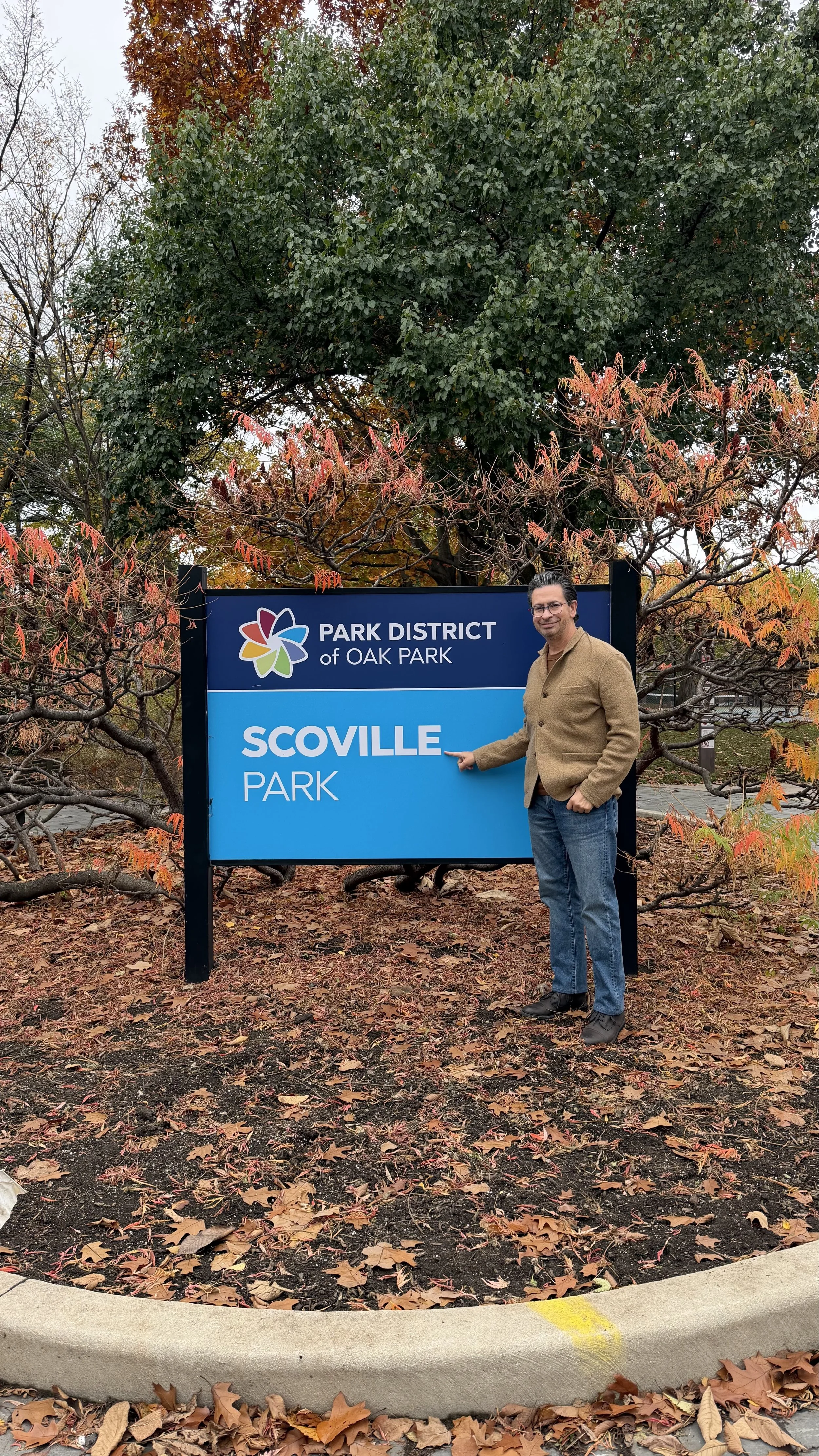
Two Scovilles, one Oak Park corner
James Scoville funded the library building that once stood at 834 Lake Street. Charles B. Scoville owned the land that became the park and advocated for the creation of the Park District. The two places still sit side by side at Lake Street and Oak Park Avenue.
The Scoville Institute started as a private subscription library in 1888. Oak Park voters approved public funding in 1902, and the institute became home to the public library the following year. A replacement building was dedicated in 1964, and today’s Main Library opened in 2003 at the same address. People have been coming to this spot for books for more than a century.
How Scoville Park became Oak Park’s village green
The Park District dates its acquisition of Scoville Park to 1913, a year after the district was formed. The park gained a Liberty flagpole in 1915, and on Armistice Day in 1925, the community dedicated Peace Triumphant to the people from Oak Park and River Forest who served in World War I.
Jens Jensen designed the original landscape, and the Park District says much of his design survives. If you know his work at Chicago’s Humboldt Park, where he extended a lagoon into a winding waterway, Scoville is another place to see how he approached a public park.
A familiar face outside the library
Look for the bust of Dr. Percy L. Julian near the Main Library. Julian was a chemist and longtime Oak Park resident whose research helped lead to treatments for arthritis and glaucoma. He held more than 130 patents. When he moved his family to Oak Park in 1950, their home was firebombed twice. The bust, unveiled in 2003, marks a local connection to both his scientific work and the village’s civil rights history.
Next time you stop at the Main Library, take the long way back through Scoville Park.